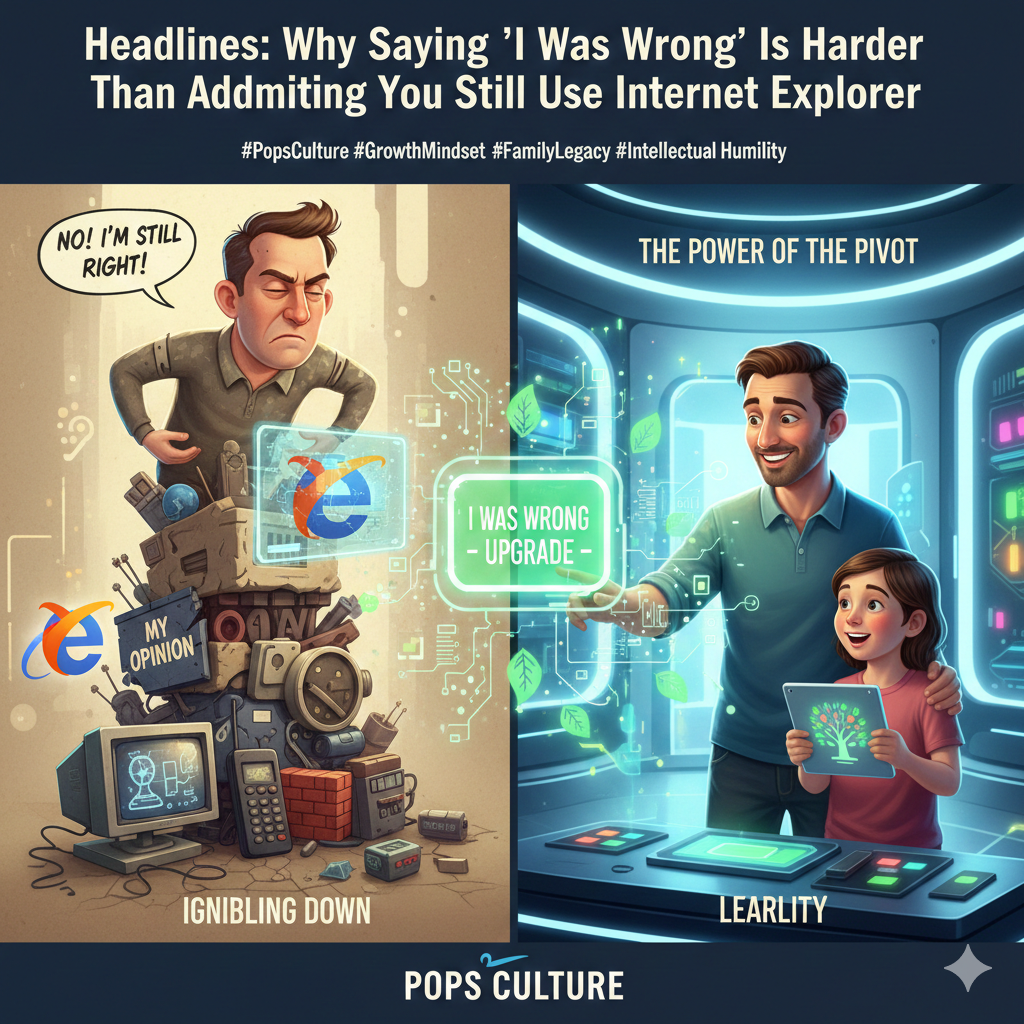
Why Saying “I Was Wrong” Is Harder Than Admitting You Still Use Internet Explorer
Hey Pops Culture fam! Let’s get real for a minute. We love debating our favorite movie endings, the best console generation, or whether a hot dog is a sandwich (it is, fight me). But there’s one debate we often have with ourselves that’s way tougher: admitting when we’re flat-out wrong.
You know the feeling, right? Someone drops a truth bomb, hits you with irrefutable facts, and suddenly your carefully constructed opinion starts to wobble like a Jenga tower. What do we do? Do we say, “Huh, good point! I learned something new”?
Nope.
More often than not, we double down. We dig our heels in, invent new reasons why we’re actually still right, or even attack the person who dared to present evidence. It’s like our brain’s default setting is “defend at all costs,” even if “at all costs” means clinging to ignorance tighter than a kid to their last Halloween candy.
The Ego’s Force Field: Why We HATE Being Wrong
Psychologists call this the Backfire Effect, and it’s basically our ego throwing a tantrum. When our core beliefs or opinions are challenged, our brain sees it as a threat. And what do we do when threatened? We fight back! Admitting we’re wrong feels like a loss, a defeat, a moment of weakness.
But here’s the kicker: it’s the exact opposite.
Doubling down isn’t a sign of strength; it’s the insecurity talking. It’s like trying to run Cyberpunk 2077 on a potato PC you’re just creating more bugs and crashing the system.
Changing your mind? That’s the real superpower. It shows you’re flexible, intelligent, and mature enough to prioritize truth over ego. It’s the ultimate brain upgrade!
Especially When The Kids Are Watching… 👨👩👧👦
This “doubling down” habit gets even trickier in our own homes. Imagine you tell your kid something confidently, only to realize you were mistaken. Maybe you insisted Pluto was still a planet, or that a certain video game was for “babies.” When your kid pulls up Wikipedia or shows you proof, what’s your move?
For us parents, admitting a mistake to our kids or partner can feel like a direct hit to our “authority” shield. We think, “If I say ‘I was wrong,’ they won’t respect me anymore.”
But guess what? It’s the opposite again!
When we refuse to admit we’re wrong, we’re actually teaching our kids some pretty unhelpful lessons:
• Mistakes are shameful and must be hidden.
• Being “right” is more important than truth or fairness.
• Their feelings and facts don’t matter as much as our ego.
The most powerful thing you can do for your kids? Model intellectual humility.
Imagine the impact when a parent looks their child in the eye and says, “You know what? You’re right. I was wrong about that, and I’m sorry.” That moment doesn’t diminish you; it makes you a superhero. It builds trust, teaches them that learning is lifelong, and shows them that it’s okay (and even cool!) to admit you don’t know everything.
Let’s Level Up Our Humility
True growth comes not from knowing everything, but from being willing to unlearn things that aren’t true anymore. It’s like updating your favorite game sometimes you have to delete old files to make space for better graphics and smoother gameplay.
So, over to you, Pops Culture community:
• When was the last time you publicly (or even privately) admitted you changed your mind on a big topic?
• Why do you think it’s so incredibly hard for us to say “I was wrong,” especially to the people closest to us?
Drop your thoughts below. Let’s create a culture where changing your mind is celebrated, not shamed!
 Pop’s Culture